
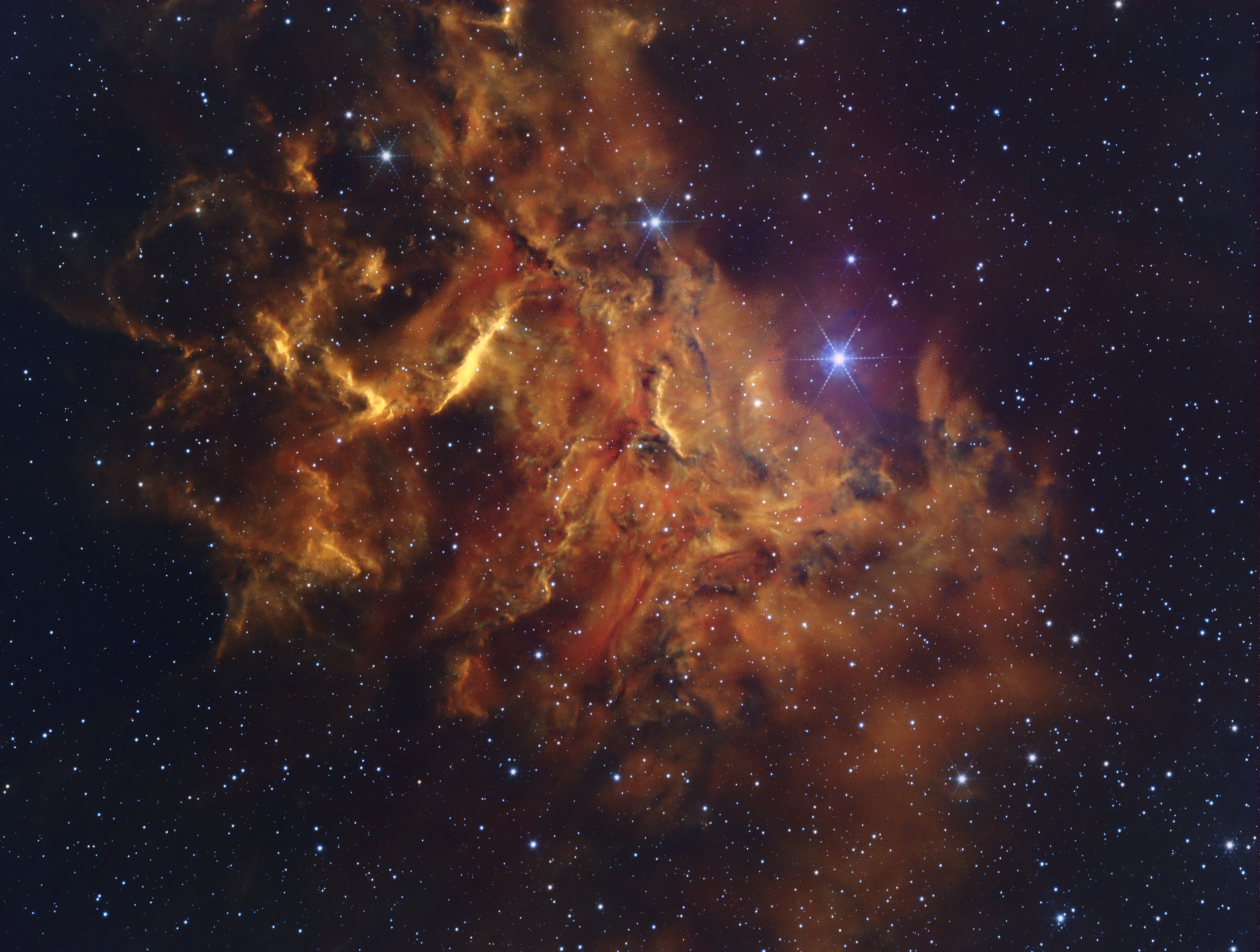
IC405 Flaming Star Nebula
The Flaming Star Nebula, or IC 405, is an emission and reflection nebula in the constellation Auriga, about 5 light-years across, and located approximately 1,500 light-years from Earth. It gets its distinctive fiery appearance from the massive, hot, runaway star AE Aurigae, which is currently moving through and illuminating its gas and dust.
AE Aurigae is an intensely hot, blue O-type star that was not formed within the nebula itself. Instead, it is believed to have been ejected from the Trapezium cluster in the Orion Nebula around 2.7 million years ago, possibly as the result of a collision between two binary star systems.
Traveling through space at a high velocity of 113 km/s (over 250,000 mph), AE Aurigae is a true runaway star. As it continues its journey through space, AE Aurigae will eventually pass through the nebula entirely. When it does, the surrounding gas will no longer be energized by its light, and the Flaming Star Nebula will eventually fade from view.
The nebula’s vivid red and blue colors are a result of two different phenomena occurring simultaneously:
- Emission nebula (red): The energetic ultraviolet radiation from AE Aurigae ionizes the surrounding hydrogen gas, causing it to glow a deep red. This process is the same as what occurs in other famous emission nebulae like the Horsehead Nebula.
- Reflection nebula (blue): The intense blue starlight from AE Aurigae is also scattered by the nebula’s cosmic dust, producing the bright blue regions that resemble smoke or wisps. This is because interstellar dust tends to scatter blue light more efficiently than other colors, similar to how Earth’s atmosphere scatters sunlight to create a blue sky.
With an apparent magnitude of +6.0, IC 405 can be observed with binoculars or a small telescope from a dark-sky location. It is a popular target for amateur astrophotographers due to its striking contrast and unique interplay of colors.
Files from which I then processed this image is from the Web site Erellaz.com. The telescope used to image is a high-performance Newton Astrograph named Moana. The Moana Project is a collection of freely available astronomical datasets.