
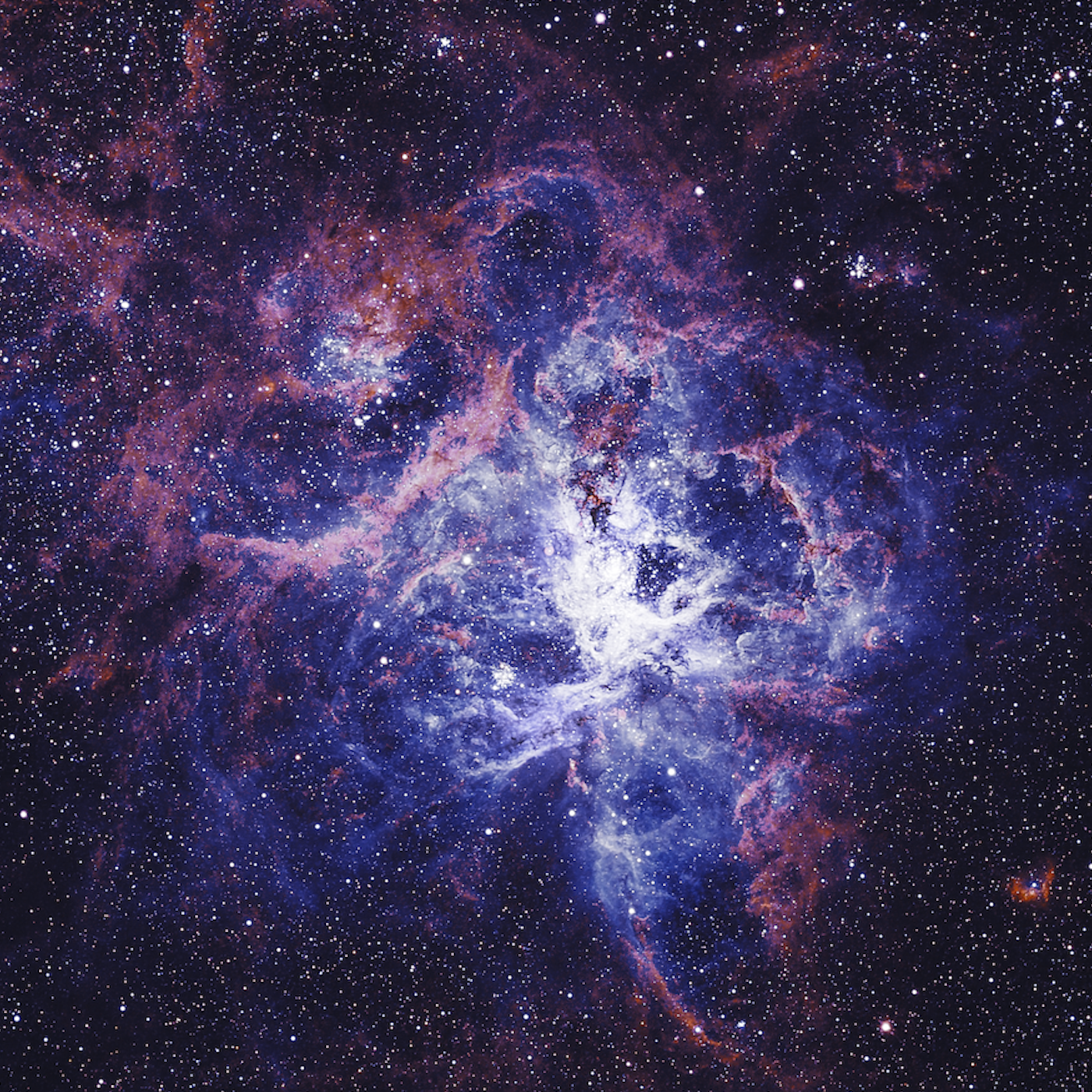
Tarantula Nebula NGC 2070
The Tarantula Nebula, also known as 30 Doradus or NGC 2070, is a massive and extremely active star-forming region located in the Large Magellanic Cloud (LMC), a dwarf galaxy neighboring our own Milky Way. It is the largest and most energetic stellar nursery in our galactic neighborhood. It is in the Southern Hemisphere.
The nebula is a dynamic “star factory” where enormous clouds of gas and dust are collapsing to form new stars. It contains several star clusters of varying ages, including the massive and young r136 cluster and the older Hodge 301.
The Tarantula is home to some of the most massive stars known, some weighing as much as 200 times the mass of our Sun. The intense radiation and powerful stellar winds from these stars are responsible for sculpting the nebula’s intricate filaments of gas and dust. The nebula’s distinctive name comes from the spidery, web-like pattern of its glowing filaments,.
Located approximately 160,000 light-years from Earth, the Tarantula Nebula is so luminous that if it were as close as the Orion Nebula, it would cast visible shadows on earth. On a dark night, the nebula can be seen with the naked eye.
Data for this image was taken using an RCOS 14.5″ f/9 Ritchey Chretien reflector telescope. The camera was an FLI PL16070. Filters were LRGB. Mount was an A-P1200GTO. Location: Rio Hurtado Valley, Chile.