
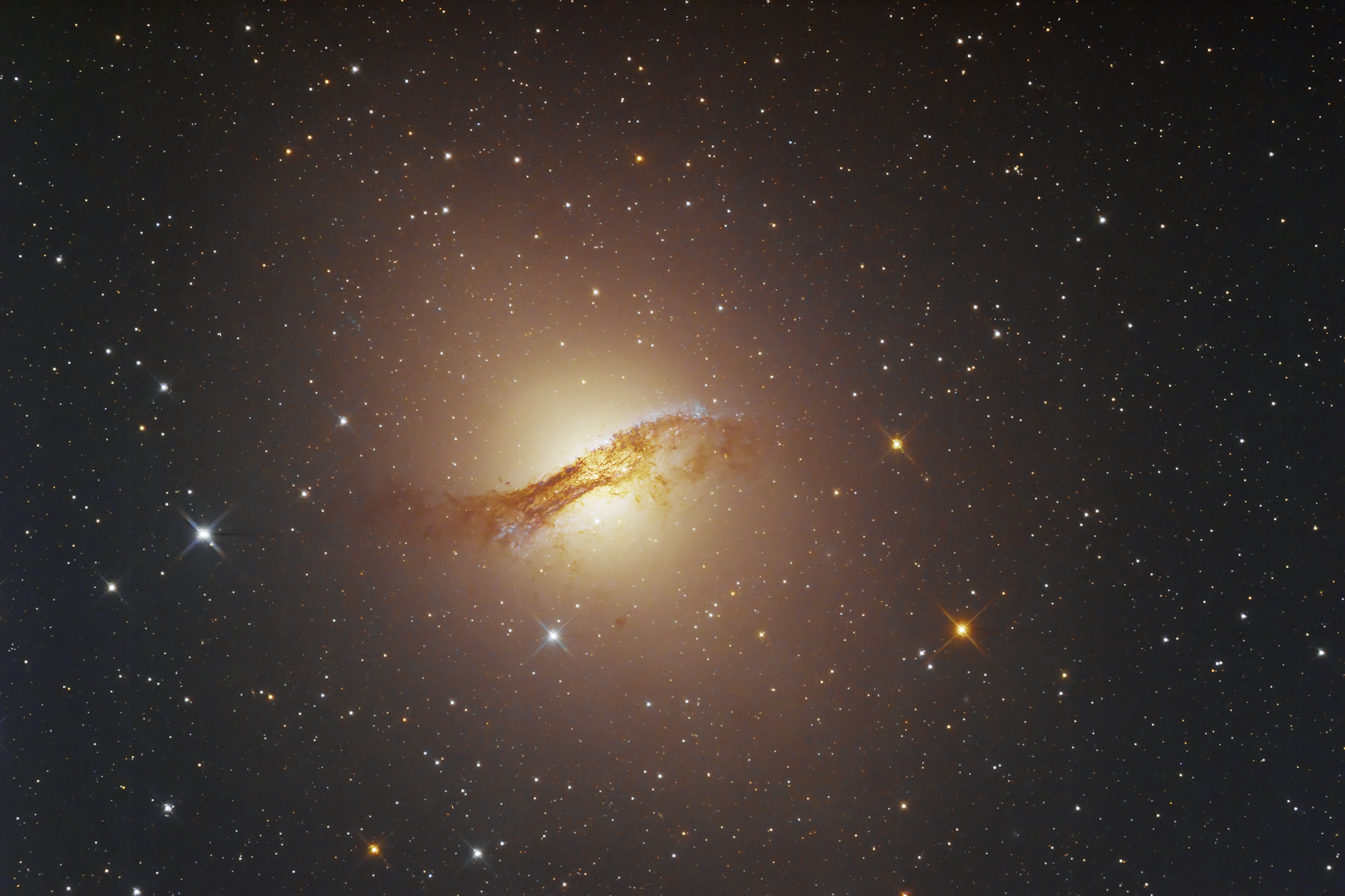
Centaurus A
Centaurus A, also known as NGC 5128, is a prominent and peculiar galaxy located about 12 million light-years from Earth in the constellation Centaurus. It is one of the closest and best-studied active galaxies, famous for its odd appearance and powerful radio emissions.
Visually, Centaurus A appears as a large, bright elliptical galaxy with a striking, dark dust lane slicing across its middle. This unusual form and structure is believed to be the result of a past merger, where a giant elliptical galaxy collided with and is absorbing a smaller spiral galaxy.
At the galaxy’s core lies an active supermassive black hole. This black hole, estimated to be 55 million times the mass of the Sun, is actively consuming cosmic material and generating vast amounts of energy across the electromagnetic spectrum.
The supermassive black hole is the source of powerful, high-energy jets that blast particles away from the core at roughly half the speed of light. While not shown in this visible light image, these jets produce strong radio and X-ray emissions that extend for more than a million light-years, making Centaurus A one of the brightest radio sources in the night sky.
The galaxy collision triggered a “firestorm” of new star formation, particularly along the dark, dusty band. This makes Centaurus A one of the closest examples of a starburst galaxy.
As the fifth brightest galaxy in the sky, Centaurus A is an excellent target for amateur astronomers in the Southern Hemisphere and low Northern latitudes. Its bright core and dark dust lane are visible even with binoculars.
Data for this image was taken using an RCOS 14.5″ f/9 Ritchey Chretien reflector telescope. The camera was an FLI PL16070. Filters were LRGB. Mount was an A-P1200GTO. Location: Rio Hurtado Valley, Chile.