Vera C. Rubin Observatory-The Boldest and Most Ambitious Telescope Yet
“I am happy to inform you that your visit has been approved for Wednesday, 15th November 2023”.
That email message came from Ranpal Gil, Head of the Communications Office for the Vera C. Rubin Observatory: We were invited to tour the most audacious astronomical observatory that was under construction!
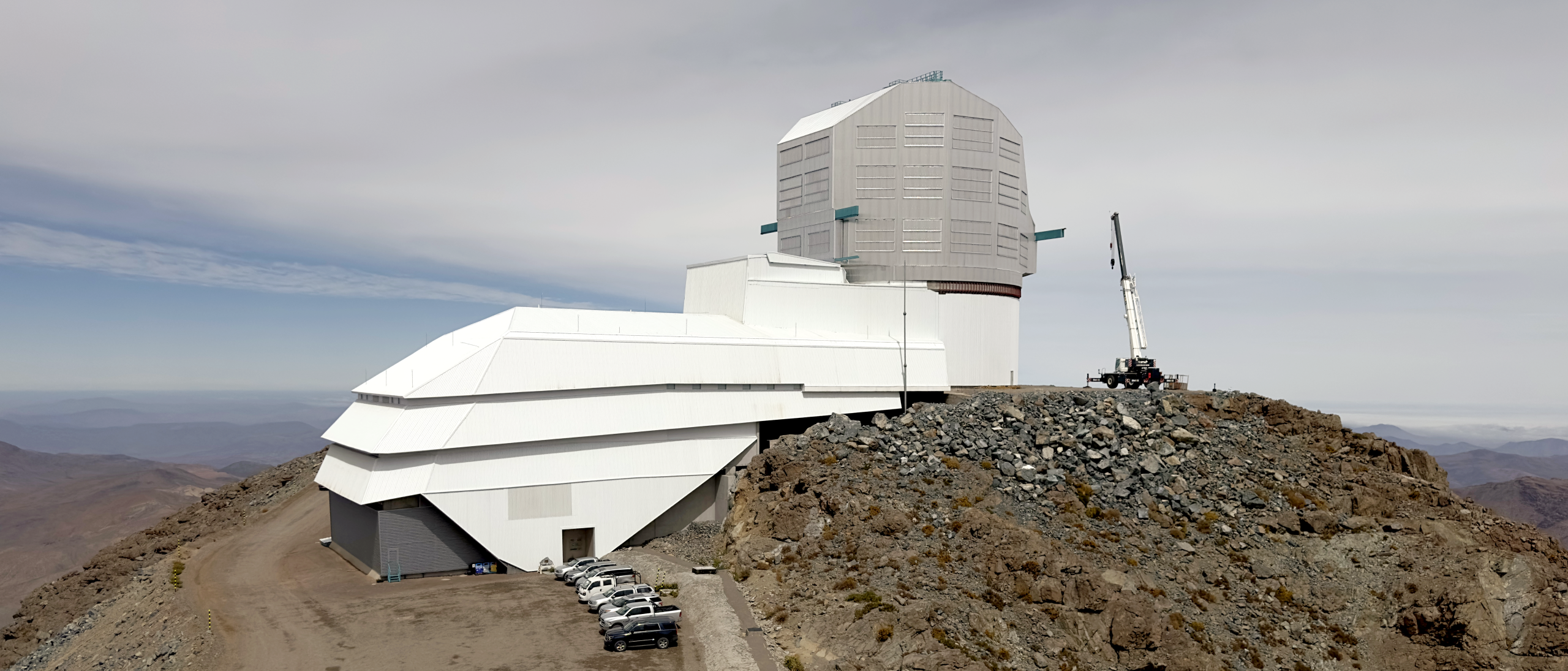
The Vera C. Rubin Observatory is a revolutionary facility located in Cerro Pachon in the deserts of north-central Chile. At an altitude of 8,700 feet, it takes advantage of excellent atmospheric conditions and one of the darkest skies in the world. Its goals are to map the distribution of dark matter and dark energy, catalog Solar System objects, conduct repeated scans of the entire Southern sky, and map the Milky Way.
Our small group of avid amateur astronomers had previously been to Chile on astronomical trips using telescopes there and with our own equipment. This time, three of us were going to spend an astro observing and imaging week at Hurtado Valley. While the Valley was a straight line distance of 5 kilometers from the Rubin Observatory, we had to drive for 2 hours over the barest road conditions in the desert.
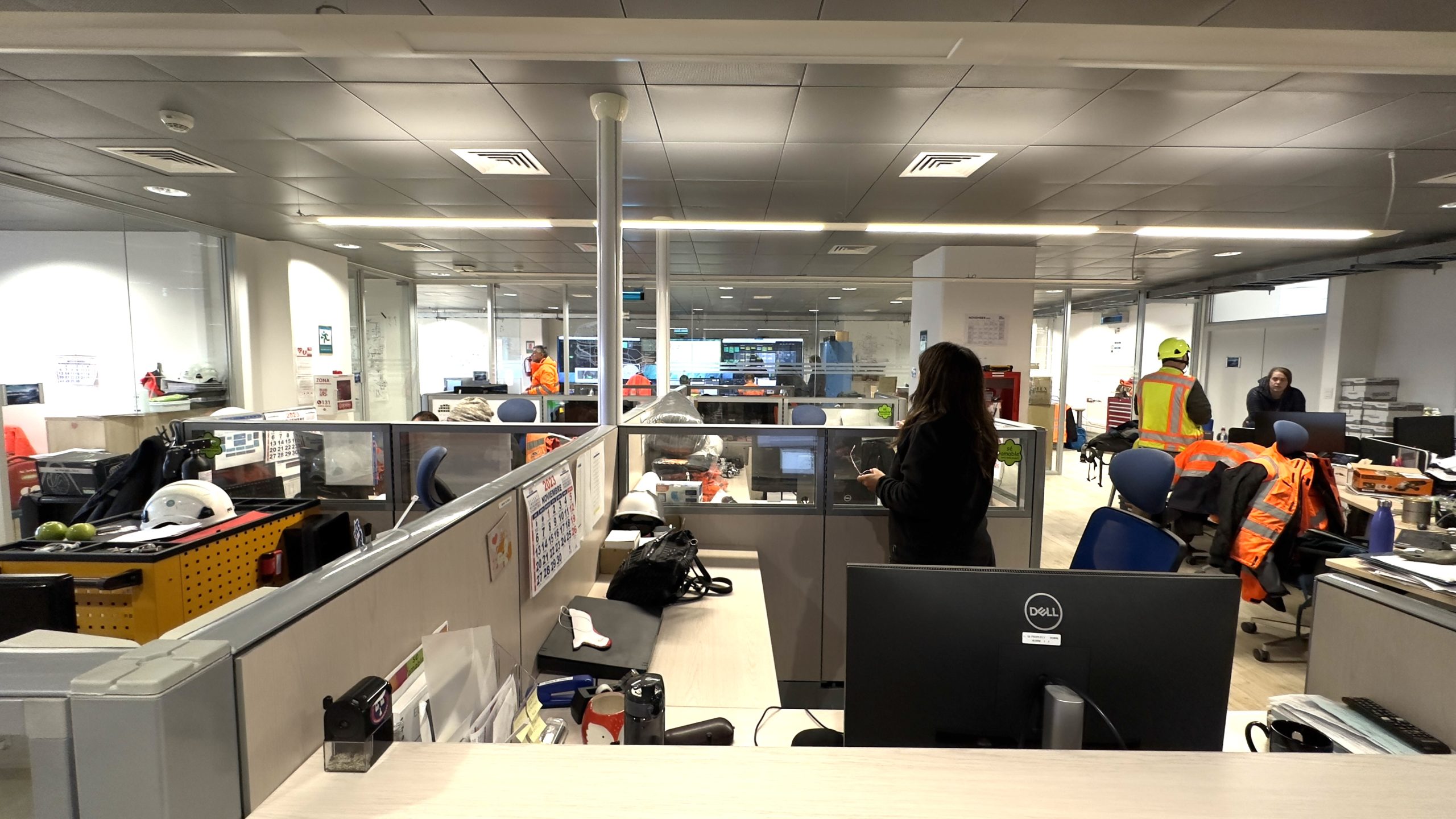
As we approached the very large Observatory structure, it was a bit incongruous to see only one small door as the entrance. So in we go, to a very small room leading up to a narrow staircase. We asked a person there where we can find Ms. Gil, and he said upstairs. Upstairs was a warren of workspace cubicles, with people intent on their work. On the far wall, enclosed within a glass partition, we could see the control room. Upon finding Ms. Gil, she introduced us to William O’Mullane, the Data Management Project Manager/Associate Director of the Observatory. He was to lead us on our tour.
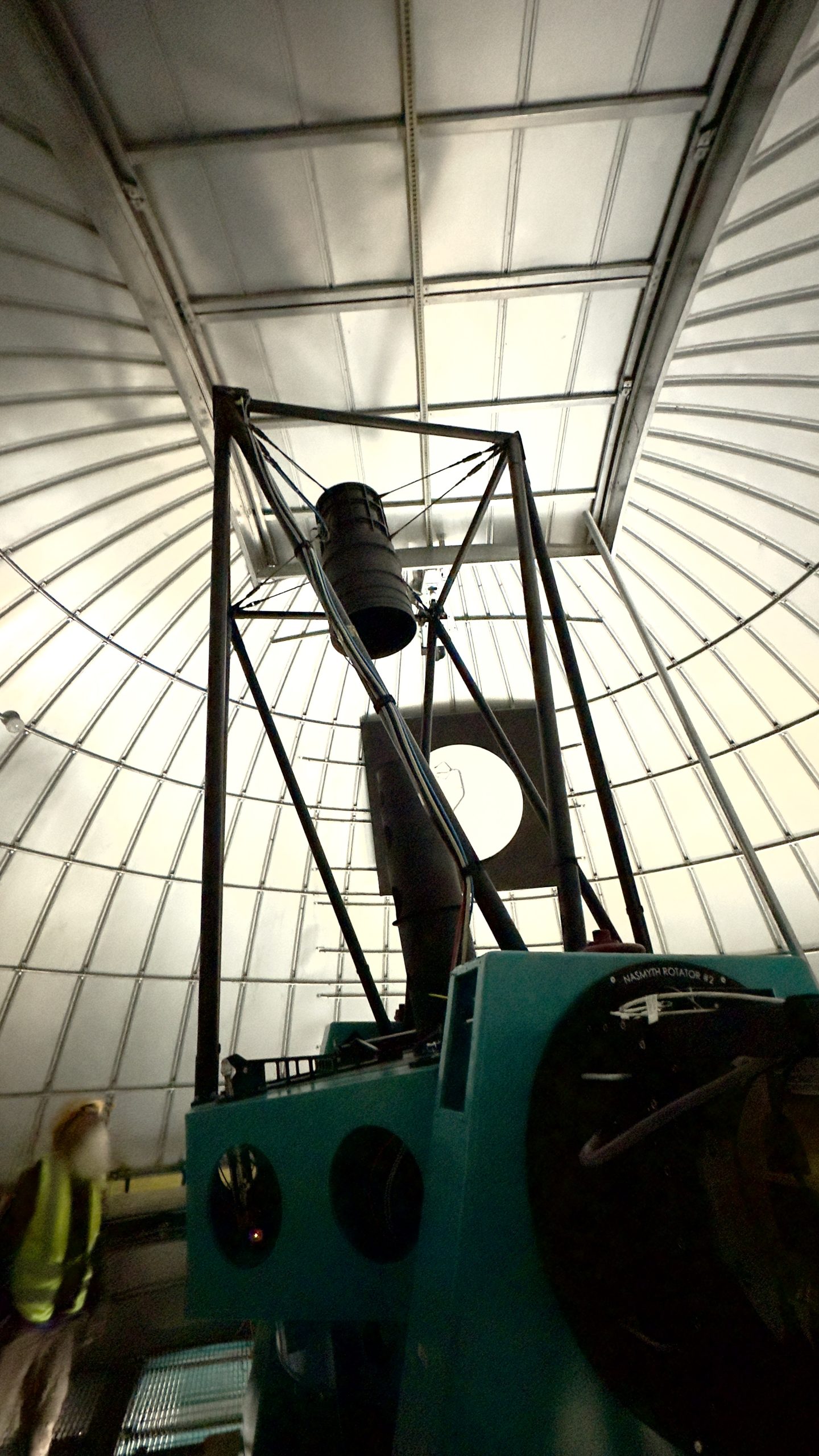
Instead of heading to the main telescope. He took us out of the building and walked us to a much smaller dome a few hundred feet away. I was wondering why that way. Upon entering, we saw an old telescope. The mystery deepened. They are using an old scope from the 1900s in a state-of-the-art observatory. What gives? Turns out, as O’Mullane explained, the old telescope plays a key role in improving the accuracy of the Observatory’s data. Called AuxTel, it’s one of the unique things about Rubin. While walking back to the main facility, O’Mullane went into an absorbing explanation of how AuxTel facilitates the use of “attenuation”, a physical phenomenon that the Observatory utilizes for data accuracy.
We entered the cavernous area where the coating chamber is situated. It is anticipated that the primary mirror will be recoated every two years, and the secondary every five years. The clean room for the camera is also in that area.
From there, we went into the innards of the facility, ending up in another chamber underneath the mount. You can see the cables coming from the telescope above, and routed down here.
Finally, we climbed the stairs and emerged into the dome. Given all the construction equipment and cranes in the dome, it seemed that the telescope structure itself was enclosed in a cocoon, being born. Cranes were moving about, with engineers and workers going here and there. Busy.
What struck me as amazing was that the length of the truss from the primary mirror to the secondary was very short given the large diameter size of the primary. It looks like the telescope is pancaked, compared to the usual image of a telescope with a long tube or truss. That short truss makes the telescope extremely fast, with a f/1.23 focal length. Also, since the telescope is meant to slew, or move, rapidly across the sky and point to another field and stop in just a few seconds, the short rigid truss avoids distortion that would otherwise be caused by flexure or bending in a longer truss structure. While the focal length of the LSST is 10.31 meters, the optical path is folded four times to enable using the short truss.
The camera, named LSST, was not yet installed while we visited. It was still at SLAC in California being built. In its place was a large piece of equipment which replicated the size, mass, center of gravity and moment of inertia of the actual camera. This was being used for balance tests and system integration.
The LSST camera’s imaging chip has 3,200 megapixels at 10 microns per pixel, measuring 25.2 inches in diameter. As a point of comparison, the iPhone 17’s main camera chip has 48 megapixels at 1.2 microns per pixel, thus is only .2% the size of the LSST. Each LSST image is 6.4 gigabytes of data while the iPhone single image is only 20 megabytes, or .3%. The LSST has a huge field of view of 3.5 degrees in order to cover large swaths of the sky in a single image. That’s 7 times the width of the Moon as we see it.
As his title suggests, O’Mullane is in charge of the data systems. The observatory will generate a torrential 20 terabytes of data per night. He pointed out the computer equipment which was in a small glass enclosed room. I was expecting banks of equipment, but it was compact given the amount of data it is supposed to handle.
From the in-house computing equipment, O’Mullane explained that the raw data is routed to the Chilean Data Access Center in La Serena, about 60 miles away, then sent to other processing facilities. It takes an ultra-fast 7 to 60 seconds via 100 gigabits per second fiber optics for the data to be transferred from the observatory to the US Data Facility at SLAC in California. This speed is crucial in order to immediately detect transient events like supernovae, gamma-ray bursts, and asteroids. Copies of the data are sent to the Rubin HQ in Arizona, U.K. and France for processing and analysis.
O’Mullane said that only 10% of the total data is going to be made public, while the other 90% will be kept by the astronomers running the observations. He expressed a bit of disappointment in that more of the data is not going to be shared immediately for citizen science.
From the dome, we went back to the control room. I had the chance to view the control monitors. The full bank of monitors I estimated covered around 18 feet across and 3 feet in height. When the LSST is operating, real-time images would be shown on those screens, for confirming exposures and doing quality checks. Other information such as telemetry and equipment performance data will be showing as well. If you’re an amateur astrophotographer, all that visual data in front of you would seem like a technical nirvana.
Our tour was intimate and technically deep since we were taken around by the person who actually ran the facilities, instead of a “tour guide”. We were there for about two hours. At tour’s end, we signed the guest book and bade much thanks and goodbye to Rampal and William.
Oh, and “attenuation” has become one of my favorite words. I try to fit it in any conversation about astronomy!
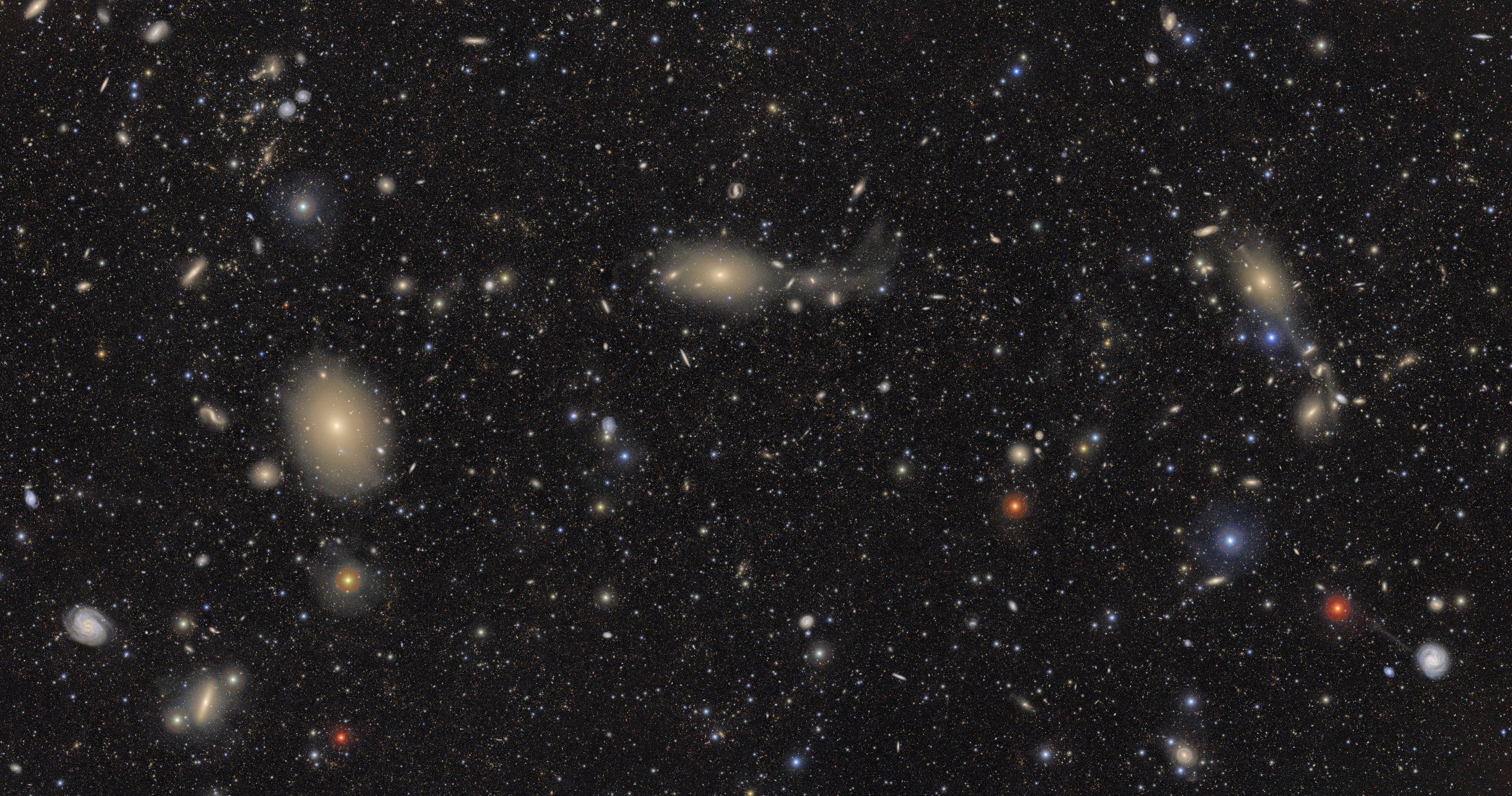
PS – In April 2025, I was quietly informed by Dr. Steven Kahn, who was Director of the Rubin Observatory from its inception in 2013 until he moved to UC Berkeley in 2022, that the LSST had just captured its first image but was holding off showing it until it held its public “first light” event. That took place in June 23, 2025. The first image is shown below.
– Manny Sawit
On the road up Cerro Pachon to the Observatory.
AuxTel telescope
SCIENCE BIT
ATTENUATION
The AuxTel telescope is used to calibrate the final images for data inaccuracies due to passage of light through the continuously varying atmosphere. Theprocess of attenuation is to approximate (or reconstruct) as accurately as possible the original characteristics of the light emitted from the various astronomical sources in the Rubin images that enter the archive. He said that the auxiliary scope would take images of the same patches of sky that Rubin is taking, at or near the same time as Rubin. A mathematical model would then be used to calculate the actual emitted intensities from the intensities captured in the data. The calculations would be iterated 4 times, in order to approach the best fit values of the model used for comparison. – John B.
Coating chambers and camera clean room.
Control room.
Control monitors.